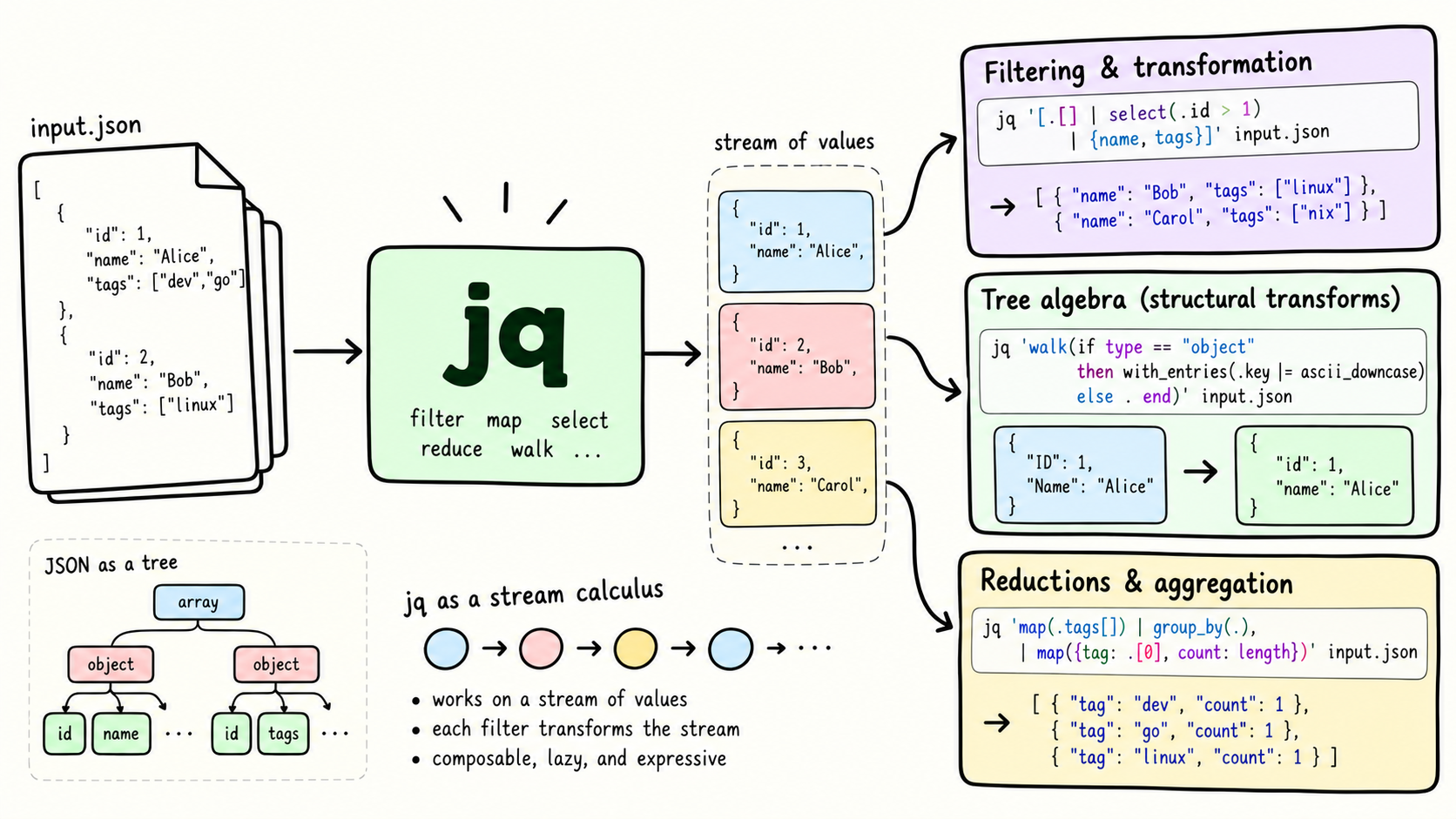
A Deep Semantic and Operational Mini-Book
This is not documentation. This is not a tutorial. This is a semantic excavation.
We will treat jq as:
-
A stream calculus
-
A purely functional reduction algebra
-
A tree traversal and rewrite system
-
A scoped evaluation engine with explicit rebinding
Note
To run a jq file do that:
Copy
$ jq -f test.jq file.json
And also some sections will implicitly reference these files
1. The Execution Model: Streams, Not Values
Every jq filter is:
Filter : Value → Stream<Value>
Even if it emits one value, it is still a stream. Even if it emits zero values, it is still a stream.
Composition:
a | b
means:
for each v in a(input):
emit b(v)
This is critical:
|
is not sequential mutation.
It is stream composition.
2. Shape Discipline: Streams vs Arrays
Given posts.json:
.[] | .title
This emits a stream of titles. NOT an array.
To collect:
[ .[] | .title ]
Collection operator:
[ stream ] : Stream<a> → [a]
This distinction is the root of most errors.
3. Reduction Semantics: add “Waits” for Structure
Consider:
.[] | .title | length | add
At
add,
.
is a number.
But
add
expects an array.
Correct:
[ .[] | .title | length ] | add
Execution flow:
Step 1: .[] emits Post
Step 2: .title emits String
Step 3: length emits Number
Step 4: [ ... ] collects Numbers into Array
Step 5: add reduces Array to Number
Important:
add
cannot begin until the array is fully constructed.
This is structural waiting, not concurrency.
4. group_by vs reduce: Structural vs Algebraic Grouping
Structural grouping
sort_by(.userId)
| group_by(.userId)
| map({ meanTitleLen: map(.title | length) | add / length })
| sort_by(.meanTitleLen) | reverse | .[:3]
Execution:
Array<Post> → sorted Array<Post> → Array<Array<Post>> → map over groups → produce Array<Summary> → sort_by mean → reverse → slice top 3
reverse and slicing
reverse : [a] → [a] (reorders elements)
.[:n] : [a] → first n elements
.[m:n] : slice range
These are structural array transforms. They do not operate on streams.
5. reduce: Generator Scope vs Update Scope (Deep Explanation)
The previous explanation described the two scopes mechanically. But this example is doing something deeper:
It is emulating group_by using a fold.
Consider:
reduce .[] as $p ({};
.[$p.userId | tostring] |= (
. // {lengths:[], maxn: 0}
| {
lengths: (.lengths + [($p.title | length)]),
maxn: (
if ($p.title | length) > .maxn
then ($p.title | length)
else .maxn
end
)
}
)
)
What group_by normally does
If we wrote:
sort_by(.userId)
| group_by(.userId)
We would obtain:
Array<Post>
→ Array<Array<Post>>
That is structural grouping.
It requires:
-
Sorting first
-
Holding the entire array in memory
-
Building nested arrays
-
Running a second aggregation pass with
map
It constructs structure first. Then aggregates.
What reduce does instead
reduce performs incremental grouping.
reduce GEN as $x (INIT; UPDATE)
Is equivalent to:
foldl UPDATE INIT (GEN(input))
In this example:
GEN = .[]
INIT = {}
UPDATE = object accumulation
We iterate over posts one by one.
What the accumulator represents
The accumulator starts as:
{}
After several iterations, it becomes:
{
"1": { lengths: [...], maxn: ... },
"2": { lengths: [...], maxn: ... },
...
}
This is a map keyed by userId.
Each key holds aggregated statistics for that group.
That is exactly what group_by + map would compute —
but without ever building nested arrays.
Why the two scopes matter
During execution:
GEN scope:
"." = each post
$p = that post
UPDATE scope:
"." = accumulator object
$p = current post
Two separate "." worlds.
Inside UPDATE:
.[$p.userId | tostring]
Means:
"Access the accumulator bucket corresponding to this post's userId."
If it does not exist yet:
. // {lengths:[], maxn: 0}
Initializes it.
Then it updates:
-
Appending the title length
-
Updating the maximum title length
Why this emulates group_by
Conceptually:
group_by(.userId)
| map(aggregate)
Does:
1. Partition into groups
2. Aggregate each group
reduce does:
For each element:
Find its group bucket
Update that bucket
Instead of building:
Array<Array<Post>>
It builds:
Object<UserId → Aggregates>
It performs grouping and aggregation simultaneously.
Structural vs Algebraic Grouping
group_by is structural:
-
Rearranges the data
-
Creates nested arrays
-
Requires sorting
reduce is algebraic:
-
Keeps original order irrelevant
-
Updates buckets in constant time
-
Never constructs intermediate nested arrays
It is a streaming group-by.
The deeper insight
group_by builds structure, then folds.
reduce folds while grouping.
One is two-phase.
The other is single-pass.
That is why this pattern emulates group_by — but in a more algebraic and memory-efficient way.
6. Recursion: Evaluation Order and Waiting
Example
def flatten_tree: if type == "array" then map(flatten_tree) | add else . end; flatten_tree
Input:
[1,[2,[3,4]],5]
Flow:
flatten_tree([1,[2,[3,4]],5])
→ map(flatten_tree)
→ flatten_tree(1) = 1
→ flatten_tree([2,[3,4]])
→ map(flatten_tree)
→ flatten_tree(2) = 2
→ flatten_tree([3,4])
→ map(flatten_tree)
→ flatten_tree(3) = 3
→ flatten_tree(4) = 4
→ add([3,4]) = 7
→ add([2,7]) = 9
→ flatten_tree(5) = 5
→ add([1,9,5]) = 15
Important:
-
mapwaits for each recursive call to return. -
addwaits for full array from map. -
Evaluation is depth-first.
7. type and walk
type
inspects structure:
"string"
"number"
"array"
"object"
"boolean"
"null"
walk(f)
recursively applies f bottom-up.
Uppercase all strings (nested.json)
walk( if type == "string" then ascii_upcase else . end )
walk semantics:
descend to leaves
apply f to leaves
reconstruct upward
Bottom-up traversal.
8. paths, getpath, setpath: Tree Calculus
Enumerate scalar leaves
paths(scalars) as $p | { path_location: $p, value: getpath($p) }
Here:
-
pathsemits path arrays -
.becomes a path -
Original root must be captured if needed
Why capture root?
. as $root | paths as $p | select($root | getpath($p) == "rust") | ($p[0:-1]) as $parent | $root | getpath($parent)
After
paths,
"."
is a path array.
Not the document.
So:
. as $root
preserves original context.
9. Ancestor Slicing: Upward Traversal
A path:
["departments",0,"teams",1,"members",0,"skills",0]
Parent:
$p[0:-1]
Grandparent:
$p[0:-2]
General:
$p[0:-n]
This is structural upward movement.
10. Structural Rewrite with reduce + setpath
Add remote:true to members with skill "rust"
. as $root
| reduce ( paths as $p | select(getpath($root | $p) == "rust")
| ($p[0:-2]) ) as $member ($root; setpath($member + ["remote"]; true) )
Semantics:
Generator finds paths to "rust"
Moves up two levels
Reduce accumulates updated root
Each iteration returns new root
Purely functional. Each setpath returns new structure.
11. getpath and setpath — Deep Semantics (Expanded)
Core idea:
A path in jq is not traversal.
It is data describing traversal.
getpath interprets that data.
setpath constructs a new structure using that data.
1. What Is a Path?
A path is an array of segments. Each segment is either:
- String → object key
- Number → array index
Example JSON:
{
"departments": [
{
"teams": [
{ "name": "compiler", "members": 5 },
{ "name": "runtime", "members": 3 }
]
}
]
}
Path to "runtime":
["departments", 0, "teams", 1, "name"]
The path is plain data. It contains no execution.
2. Formal Semantics of getpath
getpath : (JSON, Path) → JSON
Given a current context ".", and a path array:
getpath(["a", 0, "b"])
jq evaluates:
(((.["a"])[0])["b"])
Conceptually:
function getpath(root, path):
current = root
for segment in path:
current = current[segment]
return current
Important:
getpath does not modify structure.
It is pure navigation.
3. setpath — Structural Reconstruction
setpath(PathArray; Value)
setpath : (JSON, Path, JSON) → JSON
Key insight:
jq structures are immutable.
setpath does not mutate.
It reconstructs the tree.
If we do:
setpath(["a",0,"b"]; 42)
jq conceptually performs:
function setpath(root, path, value):
if path is empty:
return value
head = path[0]
tail = path[1:]
copy = shallow_copy(root)
copy[head] = setpath(root[head], tail, value)
return copy
So only the nodes along the path are rebuilt. The rest of the tree is structurally shared.
4. getpath vs Direct Access
These are equivalent:
.["a"][0]["b"]
getpath(["a",0,"b"])
Difference:
- Direct access hardcodes traversal.
getpathmakes traversal data-driven.
That enables meta-programming.
5. Data ↔ Structure Duality
paths turns structure into data:
paths
produces:
Stream<Path>
Then:
getpath($p)
turns data back into structure traversal.
This is a reversible bridge:
Structure → Data → Structure
6. Scoping Is Critical
Both getpath and setpath
operate relative to the current ".".
Example:
. as $root
| paths as $p
| select(getpath($p) == "runtime")
After paths, "." becomes a path array.
If you do:
getpath($p)
it will try to interpret the path relative to the path itself — not the original document.
Correct version:
$root | getpath($p)
Always remember:
getpath and setpath are relative to "."
7. Structural Rewrite Pattern
Canonical rewrite:
. as $root
| reduce (paths as $p | select(...)) as $target
($root; setpath($target; NEW_VALUE))
Interpretation:
- Find structural coordinates
- Use them to reconstruct a new tree
No mutation. Only pure structural rebuilding.
8. Algebraic View
Think of JSON as a tree.
A path is a coordinate.
getpath is coordinate evaluation.
setpath is coordinate rewrite.
Together they form a minimal tree algebra.
9. Mental Model
"." = current root
Path = list of instructions
getpath = interpret instructions
setpath = rebuild tree along instructions
Once internalized, jq stops being a query language. It becomes programmable tree transformation.
12. Two-Scope Problem
.value | . as $u | . + { anyAboveMean: ($u.lengths | any(. > $u.meanTitleLen)) }
Inside
any,
"."
is each element.
Outer "."
would be lost.
So:
. as $u
captures outer binding. Lexical closure simulation.
13. flatten vs flatten(1)
From your structural wrapper example:
[[[[ pipeline ]]]] | flatten(1)
flatten removes nested arrays. flatten(1) removes one level only.
Important distinction:
flatten is structural
.[0] is positional unwrap
14. Full Aggregation Pipeline with Scope Isolation
def mean: add / length;
[[
del(.[] | .body)
| map(select(.userId >= 4))
| reduce .[] as $p ({}; .[$p.userId | tostring]
|= ( . // {lengths:[], maxn: 0}
| { lengths: (.lengths + [($p.title | length)]),
maxn: (if ($p.title | length) > .maxn then ($p.title | length)
else .maxn end) } ) )
| map_values( . + { meanTitleLen: (.lengths | mean),
anyLongTitle: (.lengths | any(. > 50)),
allLongTitles: (.lengths | all(. > 20)) } )
]]
| flatten
| .[0]
| to_entries
| map( .value + { userId: (.key | tonumber) }
| . as $u
| . + { anyAboveMean: ($u.lengths | any(. > $u.meanTitleLen)) } )
| sort_by(.maxn)
| reverse
| (max_by(.maxn).maxn) as $gmax
| map(. + { globalMax: $gmax })
| .[:3]
Observe:
-
Wrapper arrays force delayed evaluation.
-
flatten resolves structural staging.
-
.[0] unwraps single layer.
-
reverse + .[:3] implements top-N.
-
Global aggregate captured with
as.
15. Mental Model Summary
"." = current context
map(f) = rebind "." to element
any/all = rebind "." to element
reduce = two separate scopes
paths = "." becomes path array
as $x = lexical capture
reverse = array reorder
.[:n] = structural slice
[0:-n] = ancestor slicing
walk = bottom-up recursive transform
add = fold over array (waits for structure)
Closing
jq is:
-
A streaming calculus
-
A fold algebra
-
A tree rewriting system
-
A scoped evaluation machine
Once you internalize:
Rebinding of "."
Structural vs Stream
Generator vs Update scope
Upward vs downward traversal
You no longer “write jq”. You derive jq.
Part II — Formal Semantics, Category Theory, and Execution Visualization
17. A Formal Evaluation Model
Let’s define jq more formally.
A jq filter is a function:
F : JSON → Stream(JSON)
A stream is an ordered (possibly empty) sequence of values.
Composition:
(a | b)(x) = flatten( map(b, a(x)) )
This is Kleisli composition for the list monad.
jq is literally programming in the Kleisli category of lists.
18. Evaluation Diagram for Pipe Composition
Consider:
.[] | .title | length
Formal evaluation:
Input: [Post]
Step 1: .[] : [Post] → Stream<Post>
Step 2: .title : Stream<Post> → Stream<String>
Step 3: length : Stream<String> → Stream<Number>
Graphically:
Input Array
│ .[]
│ Stream<Post>
│ .title
│ Stream<String>
│ length
│ Stream<Number>
Important: Each stage consumes a stream and produces a stream.
19. Reduce as a Fold (Catamorphism)
reduce is a fold.
reduce GEN as $x (init; update)
Equivalent to:
foldl update init (GEN(input))
Where:
This is a left fold.
20. Monoids in jq
Many jq operations are monoidal.
-
addover numbers → (+, 0) -
addover arrays → (concat, []) -
addover objects → (merge, {}) -
any→ (OR, false) -
all→ (AND, true)
Monoid structure:
(identity, associative combine)
Example:
[true, false, true] | any
Equivalent to:
false OR true OR false OR true
Monoidal reduction.
21. map as Functor
map(f) obeys functor laws:
map(id) = id
map(f ∘ g) = map(f) ∘ map(g)
Because:
map(f) = collect(.[] | f)
It preserves structure.
Contrast:
.[] destroys structure (becomes stream)
map preserves structure (returns array)
So arrays form a functor.
22. walk as a Recursive Algebra
walk(f) is a bottom-up traversal.
Category-theoretically, this is a catamorphism over the JSON tree.
Example:
walk( if type == "string" then ascii_upcase else . end )
Evaluation:
Traverse children
Apply f to children results
Reconstruct parent
This is a structural fold.
23. Tree Algebra Model
JSON is an algebraic data type:
JSON = Null | Boolean | Number | String | Array [JSON] | Object {String: JSON}
paths transforms structure into data:
Tree → Stream < Path >
getpath interprets data as structure traversal:
(Path, Tree) → Value
setpath constructs new structure:
(Path, Value, Tree) → Tree
Thus jq allows:
Structure ↔ Data
This is meta-programming over trees.
24. Generator vs Update Scope Diagram
Consider:
reduce .[] as $x (0; . + $x)
Execution model:
GEN context: "." = each element of input array
UPDATE context: "." = accumulator
$x = element
Diagram:
Input Array
│ GEN (.[])
│ Stream<Element>
│ reduce loop:
│ accumulator₀ = 0
│ accumulator₁ = accumulator₀ + element₁
│ accumulator₂ = accumulator₁ + element₂
...
Two separate scopes. Always remember this.
25. Execution Visualizer Mental Model
Imagine jq as a machine with:
-
A current value register "."
-
A stream buffer
-
A scope stack for variables
-
A structural stack for recursion
When you write:
. as $root | paths as $p | ...
Machine does:
Register "." = input
Push $root
Run paths:
For each path:
Register "." = path
Push $p
Evaluate body
Variables are lexical captures. Not dynamic global references.
26. Visualizing Recursion Internally
flatten_tree recursion:
Call stack:
flatten_tree([1,[2,[3,4]],5])
flatten_tree(1)
flatten_tree([2,[3,4]])
flatten_tree(2)
flatten_tree([3,4])
flatten_tree(3)
flatten_tree(4)
Return stack:
3 + 4 = 7
2 + 7 = 9
1 + 9 + 5 = 15
map builds array before add. add reduces array.
So:
Recursion builds structure.
Reduction collapses structure.
27. Slices and Ordering as Algebra
reverse:
reverse : [a] → [a]
Pure permutation.
Slicing:
.[:n]
.[m:n]
.[-n:]
These are structural projections. Not stream operators.
Ancestor slicing in paths:
$p[0:-1]
$p[0:-2]
Is path projection.
28. jq as Kleisli Category Programming
Because every filter returns a stream, jq operates in:
Kleisli(List)
Composition:
f >=> g
Which is:
x ↦ flatten(map(g, f(x)))
That is literally jq's pipe.
29. Final Unified Model
jq combines:
-
Functor (map)
-
Fold (reduce, add, any, all)
-
Monoid (aggregation)
-
Catamorphism (walk)
-
Kleisli composition (|)
-
Tree algebra (paths, getpath, setpath)
-
Lexical scoping (as)
It is not a scripting language. It is a small algebra over streams and trees.
Closing Reflection
When something breaks in jq:
-
You misunderstood what "." is.
-
You confused stream with array.
-
You crossed generator scope with update scope.
-
You forgot to capture context with as.
-
You attempted structural operation on a stream.
Once those invariants are internalized, jq becomes derivable, not memorized.
It stops being syntax. It becomes algebra.